Blog · Journal
Aura Vision: Smart Glasses to Reveal Our Hidden Glow
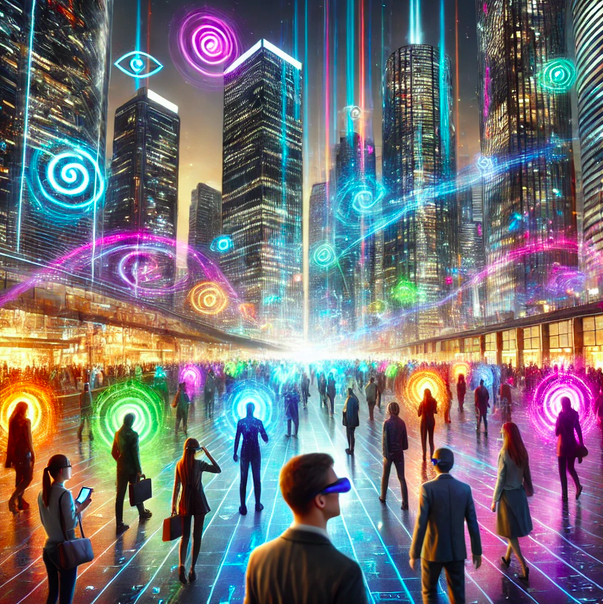
What if you could slip on a pair of glasses and see the invisible energy fields—auras—swirling around people’s bodies? It sounds like sci-fi or mysticism, but with today’s tech, we might be closer to making it real than you think. Inspired by a mix of cutting-edge science and age-old spiritual lore, let’s imagine a world where aura-seeing glasses bring a hidden layer of human experience into focus.
The Spark of an Idea
The concept of auras—colorful halos reflecting our emotions, health, or spirit—has danced through cultures for centuries, from Hindu chakras to New Age healers. Science, though, is skeptical. We don’t naturally emit visible “rainbow light,” but our bodies do give off faint biophotons—tiny bursts of light from cellular reactions, too dim for the naked eye. Add in electromagnetic fields (EMF) from our nerves and the quirky glow of Kirlian photography, and there’s enough raw material to wonder: could we build glasses to see it?
Designing the Aura Specs
Picture sleek AR glasses—think Ray-Ban’s chic frames with a futuristic twist. The lenses shimmer faintly, embedded with micro-sensors: light detectors for biophotons, coils for EMF, and cameras for real-time mapping. Slim modules along the temples house a processor and battery, with a pulsing LED to signal they’re on. Lightweight yet packed with power, they’d weigh no more than your favorite sunglasses, crafted from carbon fiber or graphene.
Here’s the tech breakdown:
Biophoton Boost: Ultra-sensitive CCD sensors amplify those feeble biophoton emissions a million times, rendering them as a glowing outline around your body.
EMF Color-Code: Miniature scanners read electromagnetic shifts—fast pulses for stress, slow waves for calm—translating them into colors like red or blue.
AR Magic: The lenses project a live overlay: a shimmering, 6-12-inch aura that shifts with your state. An AI fine-tunes it, learning your baseline to highlight changes.
A companion app lets you tweak the vibe—dial up the glow, switch color schemes, or track trends. Charge them on a magnetic dock, and you’re good for eight hours of aura-gazing.
A Day in the Life
Imagine wearing these in 2035:
Morning: Your aura’s a groggy purple at breakfast, sparking orange post-coffee. You filter it out to focus on the day.
Commute: On the train, strangers glow muted gray—exhausted masses—but one person’s bright green aura screams creativity. A missed connection, maybe.
Work: Your boss’s red flare warns of a rant; a coworker’s steady blue makes them your go-to ally.
Night Out: At a bar, a yellow aura catches your eye—confidence in human form. “These glasses say you’re lighting up the room,” you quip. It lands.
Self-Check: A dim gray aura one day nudges you to rest. The app agrees: “Hydrate, human.”
Beyond the Basics
Why stop at utility? Add a “mystic mode” to mimic aura lore—pink for love, black for tension. Link them to a social game where friends boost their “aura scores” with good vibes. A privacy toggle keeps strangers’ fields off-limits, dodging ethical snags.
The Reality Check
Building these isn’t easy. Shrinking lab-grade sensors into glasses demands breakthroughs in power and precision. Daylight could swamp the faint signals, and sweaty skin might throw off readings. Critics would scoff—“That’s not true auras!”—and they’d have a point; it’s a tech-enhanced guess, not proof of the metaphysical. But even as a simulation, it’d be a wild ride.
The Horizon
We’re not there yet, but the pieces are falling into place. AR glasses from Meta and bio-sensors in wearables like Fitbit show the path. Give it a decade, some hefty R&D, and a dash of imagination, and aura specs could hit the market—part science, part spectacle. They won’t settle the debate over auras’ existence, but they’d let us see each other in a whole new light. Literally.
What would you do with a pair? Stare at your own glow or scope out the crowd? Either way, the future’s looking colorful.